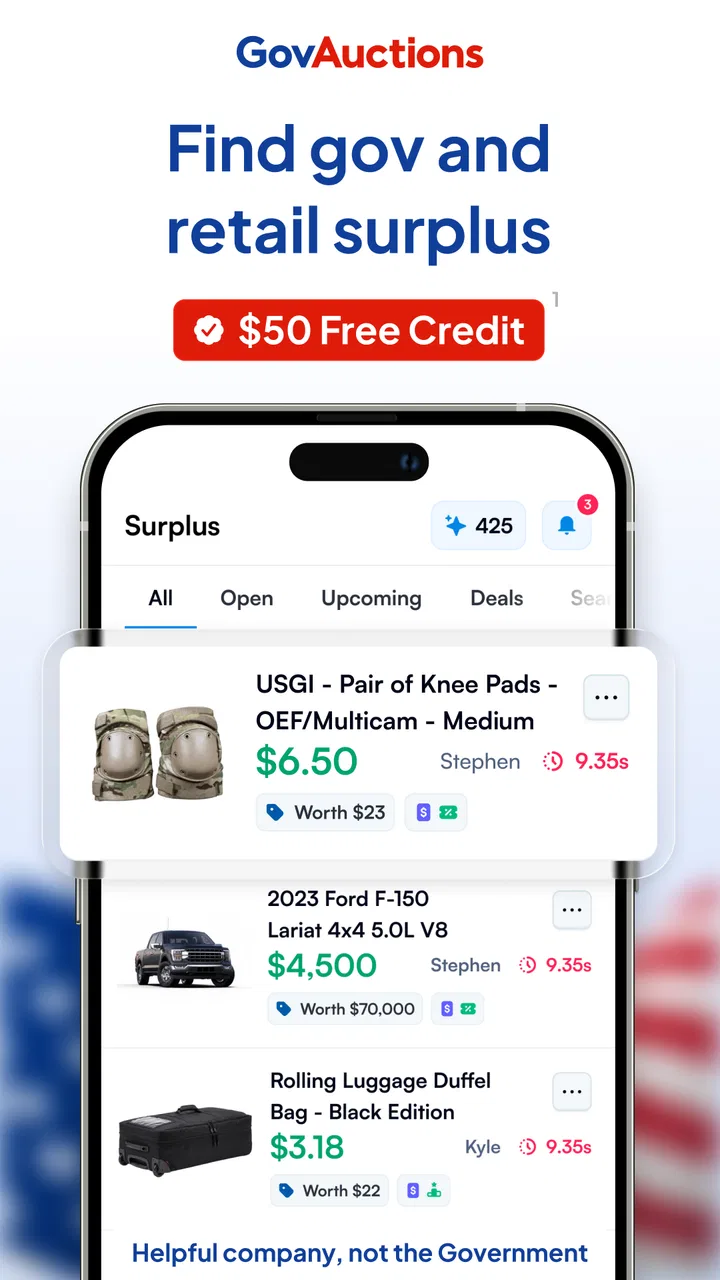
GovAuctions.com - Shop Surplus
- 4.8
- Rating
- 500.00K
- Installs
- Free
- Price

 Analysis by App-foxy
I approached GovAuctions.com - Shop Surplus as a shopping app for people who enjoy looking beyond ordinary retail shelves. Its central appeal is simple: it brings government and retail surplus opportunities into one mobile browsing experience, giving me a way to discover items that may not appear in conventional shopping apps. That focus makes it more interesting than a standard marketplace, but it also means I have to shop with more patience and judgment.
The app is free, belongs to the Shopping category, and is developed by Auctions LLC. It is rated for Everyone, so its general audience is broad. With a 4.7 average from around 5.1 thousand ratings and more than 100 thousand installs, it has clearly attracted a meaningful group of shoppers. I found that its value depends less on impulse buying and more on whether I am willing to inspect opportunities carefully before deciding what deserves my attention.
Why surplus discovery is the app’s defining capability
The most important capability here is not simply searching for products. It is discovering surplus listings that sit outside the usual retail routine. That changes the way I browse. Instead of opening the app with one exact product in mind, I can use it to explore categories, notice unusual inventory, and save possibilities for later consideration.
You May Also Like

 AccuWeather: Weather Radar
AccuWeather Review: A Quick, Clear Forecast for Everyday Decisions
For everyday plans, the best forecast is the one you can understand quickly. AccuWeather makes rain timing, radar, and local conditions easy to act on, with a few trade-offs.

 Hill Climb Racing
Why Hill Climb Racing Still Turns Crashes Into One More Run
A tiny car, a bumpy hill and one more upgrade: Hill Climb Racing keeps resurfacing because its simple chaos makes every near-miss feel personal.

 AliExpress - Shopping App
AliExpress Makes Global Shopping Feel Personal, but Shoppers Bear the Risk
AliExpress turns a global marketplace into a pocket-sized discovery engine. Its reach is useful, its shopping loop compelling, and its trade-offs easy to miss.

 Lords Mobile: Kingdom Wars
Lords Mobile Is a Kingdom-Building Routine, Not a Quick Match
A case-by-case verdict on the building, battles, device demands, and social commitments that make Lords Mobile rewarding for some players and exhausting for others.

 PDF Scanner app - TapScanner
TapScanner Makes Paperwork Easier to Capture, Check, and Share
TapScanner makes scanning with a phone feel less like a rescue operation and more like a dependable step in getting work done. Its capture tools are useful, though not flawless.

 Block Blast!
 Shows How Much a Puzzle Game Can Leave Out
A quiet grid game shows why puzzle players increasingly value instant clarity, repeatable skill and low-pressure play—and where the genre still needs to catch up.
More From Our News Desk
View All News


That distinction matters because a normal shopping app is usually built around predictable stock, familiar product pages, and quick comparisons between retailers. A surplus-focused service has a different rhythm. The appeal comes from finding something useful, unusual, or potentially affordable before making a careful decision. I see it as a discovery tool first and a checkout shortcut second.
In practical terms, this capability is most useful when I have a flexible need. If I am furnishing a workspace, replacing equipment, looking for tools, or simply checking whether a particular type of item is available through a nontraditional channel, browsing surplus can reveal options I would not normally encounter. The experience rewards curiosity, but it does not remove the responsibility of evaluating the item.
I also like that the app’s purpose is easy to understand without requiring a complicated shopping philosophy. The name points directly toward government auctions, while the store summary expands that idea to retail surplus. I can therefore open it knowing that I am not entering a conventional catalog with endless identical products. I am entering a changing pool of opportunities where the quality of the browsing process matters as much as the search itself.
What I actually do when browsing
My most useful approach is to begin with a broad category or object type, then narrow my attention only after I understand what is appearing. Starting too narrowly can make the experience feel empty if the exact item is not currently available. Starting broadly gives me a better sense of the kinds of surplus that are worth watching and helps me decide whether the app fits my shopping habits.
I treat saved items as a short-term research shelf rather than a promise to buy. When something catches my eye, I keep it in view while I compare its condition, description, likely usefulness, and the effort involved in obtaining it. This is one of the key differences from ordinary retail browsing: seeing an appealing listing is only the beginning of the decision.
A useful habit is to separate “interesting” from “practical.” An unusual item may be fun to discover but still be a poor purchase if I cannot use it, transport it, store it, or verify that it suits my needs. The app makes discovery easy; my own checklist determines whether discovery turns into a sensible purchase.
How the experience works in practice
In everyday use, I would open the app during a few spare minutes, browse current opportunities, and save anything that deserves a closer look. That workflow feels more natural here than trying to force a fast retail-style decision. I can return later with a clearer head instead of committing simply because an item looked appealing at first glance.
The app is particularly suited to a two-stage process. First comes exploration: I scan the available surplus and identify patterns, categories, or individual listings that interest me. Then comes verification: I revisit those choices and ask whether the item’s condition, description, and practical requirements make sense for my situation.
My strongest tip is to use saved listings as a decision filter, not a wish list. If I save too many items, the feature loses its value and turns into another endless feed. I get better results when I keep only listings I can explain in one sentence: what I would use it for, why it may be worthwhile, and what detail I still need to check.
This approach also helps with the unpredictable nature of surplus shopping. Traditional retail apps train me to expect a product to remain available while I compare alternatives. With surplus, I should assume that an opportunity may change or disappear and avoid building a plan around one listing alone. Saving several realistic alternatives gives me flexibility without encouraging careless purchases.
Another practical insight is to browse when I am not under pressure. If I urgently need a replacement today, a surplus discovery app may not be the right first stop. The experience is better for planned projects, flexible timelines, and shoppers who can wait for a suitable opportunity rather than accepting the first result.
A realistic everyday scenario
Imagine that I am setting up a small home workshop and need storage, equipment, or supporting supplies. A conventional shopping app would let me compare standardized products, read familiar specifications, and order something with a predictable format. GovAuctions.com - Shop Surplus gives me a different route: I can browse surplus opportunities, save promising listings, and decide whether any of them match the project closely enough to justify further attention.
In that situation, I would not judge a listing only by its apparent bargain. I would consider whether the item is appropriate for the workshop, whether its condition suits the job, and whether acquiring it would create extra work. A lower purchase cost is not automatically a better result if I need to spend significant time arranging transport, finding missing parts, or adapting the item.
The app becomes genuinely useful when my requirements are flexible. Perhaps I need storage but do not care about a particular brand, or I want equipment for a hobby and can accept cosmetic wear. Surplus browsing can be a strong match because I am evaluating function and suitability rather than demanding an exact retail package.
It is less suitable if I need a guaranteed model, a precise specification, or a fast replacement. In those cases, a conventional retailer may provide a clearer path from search to ownership. I would use the surplus app to look for possibilities, not to replace every other way of shopping.
The tradeoff between discovery and certainty
The same capability that makes the app interesting also creates its main friction. Surplus shopping is less predictable than buying a standard item from a familiar retail catalog. I may find something valuable, but I may also spend time browsing without finding a suitable match. That is not necessarily a flaw in the app; it is part of the type of inventory it presents.
I also have to be more disciplined about descriptions and condition. A conventional product page often lets me compare identical units. A surplus listing may require closer reading and more careful interpretation. I would never assume that an attractive image tells me everything important. The sensible approach is to examine every available detail and keep my expectations aligned with what is actually described.
There is a psychological tradeoff too. The possibility of a bargain can make an item feel more urgent than it really is. I found it helpful to pause before treating a low-looking price or unusual object as a must-have. The right question is not “Can I get this?” but “Would I still want this if it were not presented as a special opportunity?”
For that reason, the app is not ideal for shoppers who want a completely frictionless purchase journey. If I value standardized inventory, straightforward returns, immediate availability, and minimal research, a mainstream shopping app will probably feel easier. GovAuctions.com - Shop Surplus asks me to participate more actively in the buying decision.
Another tradeoff is attention. Discovery can be enjoyable, but browsing without a clear purpose can consume time. I recommend setting a simple limit before opening the app: perhaps I am checking for workshop equipment, office items, or a specific kind of surplus. That small boundary keeps the experience useful and prevents random browsing from becoming the only activity.
Who benefits most from this approach
The best audience is made up of practical explorers. These are shoppers who enjoy comparing possibilities, can tolerate changing inventory, and are willing to examine an item before deciding. DIY users, collectors, small project planners, bargain hunters, and people furnishing a space may find the discovery angle especially appealing.
It can also help anyone who has a broad goal instead of a rigid product requirement. If I need “something suitable for storage” rather than one exact cabinet, or “equipment for a project” rather than a specific new model, I have more room to benefit from surplus browsing. Flexibility turns the changing inventory from a problem into an advantage.
People who should skip it, or at least use it only as a secondary option, are shoppers with urgent deadlines and exact specifications. If I need a particular replacement part immediately, want a sealed retail product, or do not have time to research an unfamiliar listing, the app may add more uncertainty than value. In those cases, a standard retailer or a specialized marketplace is likely to serve me better.
The app is also not a substitute for personal judgment. Its free price makes trying it easy, and the Everyone rating makes it broadly approachable, but those points do not turn every listing into a safe or sensible purchase. I still need to think about suitability, condition, logistics, and the total effort involved.
How it compares with ordinary shopping apps
Compared with a major retail app, this experience feels less like filling a shopping cart and more like monitoring opportunities. Retail apps win when I know exactly what I want and care about predictable stock, standardized descriptions, and quick fulfillment. GovAuctions.com - Shop Surplus wins when I am open to alternatives and want access to a different kind of inventory.
Compared with a general peer-to-peer marketplace, the appeal is more focused. A broad marketplace may contain almost anything, but that variety can make it difficult to identify surplus-related opportunities. Here, the shopping purpose is clearer from the start. The tradeoff is that I should not expect the same breadth or consistency as a general marketplace.
Compared with browsing auction websites in a desktop browser, the mobile format is more convenient for quick checks and saved discoveries. I can make the app part of a routine instead of waiting until I am sitting at a computer. That convenience is valuable, but it also makes self-control important: a phone makes it easy to browse casually, so I need to keep my buying criteria visible.
The most effective strategy is to use it alongside, not necessarily instead of, familiar shopping tools. I might discover a surplus option here, then use another source to understand what a comparable new item would cost or whether the specification is suitable. That comparison prevents the excitement of discovery from replacing basic value checking.
Details that affect whether I would keep using it
The app is free, which lowers the barrier to experimenting with this style of shopping. I can explore the concept without paying for access, then decide whether the available opportunities fit my habits. Its current version is 7.8.0, and it supports devices running Android 7.0 or later, making it accessible to many older Android users as well as newer phones.
Those technical details matter mainly because a shopping app should be easy to keep available for occasional checking. Surplus discovery works best when I can return periodically rather than treating one visit as a complete shopping trip. A compatible older device can therefore be useful for someone who wants a dedicated browsing tool without upgrading immediately.
At the same time, I would judge the app by the quality of my decisions rather than by how long I spend inside it. The strongest use is selective: open it with a purpose, explore enough to find realistic candidates, save only the best possibilities, and return to them with a critical eye. That workflow makes the app feel like a practical research companion instead of an endless stream of temptations.
The rating of 4.7 from roughly 5.1 thousand ratings suggests that many users respond well to its general proposition. I would still interpret that positively but personally: a strong average tells me the concept connects with people, while my own satisfaction will depend on whether surplus shopping matches my expectations. Someone seeking predictable retail convenience may not feel the same enthusiasm.
My recommendation after using the app
I recommend GovAuctions.com - Shop Surplus to readers who enjoy finding nontraditional shopping opportunities and are comfortable doing more evaluation before buying. Its defining strength is the way it turns government and retail surplus into something I can browse, save, and revisit from a phone. That is more valuable than a generic catalog when I have a flexible project or want to discover alternatives.
I would not recommend treating it as a guaranteed bargain finder or as a replacement for urgent retail shopping. The app can help me locate possibilities, but it cannot make an uncertain purchase automatically practical. I need to check the listing carefully, compare the opportunity with ordinary alternatives, and consider the effort beyond the item itself.
Overall, I see it as a focused shopping app for patient, curious users. The free access and broad Everyone rating make it easy to try, while the strong average rating and growing install base show that the idea has found an audience. If you enjoy the process of finding and evaluating surplus, this app is worth keeping on your phone; if you want certainty and speed, a conventional retailer will probably be the better everyday choice.
FAQs for GovAuctions.com - Shop Surplus
01What is GovAuctions.com - Shop Surplus?
GovAuctions.com - Shop Surplus is an app that allows users to bid on government surplus items, including vehicles, electronics, and real estate. The app connects users to various government auctions, offering an easy-to-navigate platform to find and bid on items of interest. It aims to make the auction process more accessible to the general public.
02How do I place a bid on an item using the app?
To place a bid on an item, first, sign up and create an account on GovAuctions.com. Once logged in, browse the available auctions and select the item you're interested in. The app provides a step-by-step guide to placing your bid, ensuring you understand the bidding rules and deadlines. Be sure to monitor your bids as auctions can be competitive.
03Are there any fees associated with using GovAuctions.com?
Yes, while browsing items and auctions is free, there may be fees associated with bidding and purchasing items. These can include a buyer's premium or registration fees. It's crucial to review the terms and conditions within the app to understand any potential costs fully before participating in an auction.
04Is GovAuctions.com available for both Android and iOS devices?
Yes, GovAuctions.com - Shop Surplus is available for both Android and iOS devices. Users can download the app from the Google Play Store for Android or the Apple App Store for iOS. Each version offers similar features, allowing users to easily navigate auctions and manage bids on their preferred platform.
05What kind of items can I find on GovAuctions.com?
GovAuctions.com offers a wide range of surplus items from government auctions, including vehicles, electronics, machinery, and real estate. The app frequently updates its listings, providing users access to diverse items across various categories. This variety makes it a valuable tool for bargain hunters and those seeking specific government surplus deals.
Pros
- Extensive database of government auctions.
- User-friendly interface for easy navigation.
- Real-time updates on auction listings.
- Wide variety of auction categories available.
- Secure payment options for transactions.
Cons
- Subscription required for full access.
- Limited customer support options.
- Occasional app crashes reported.
- No offline mode for browsing auctions.
- Notifications can be overwhelming.

GovAuctions.com - Shop Surplus
Gallery